Creating a Golang REST API Using the Webframework + Router Chi — Learning Golang
INTRODUCTION
Hello Everyone In this article, I would like to share a tutorial on creating a REST API in Golang using the Webframework + Router Chi and the NoSQL MongoDB database.
PREREQUISITE
If you don’t have MongoDB yet, you can download it first.
Install the MongoDB and Chi Router packages first for our coding needs this time. You can open your command prompt and type the following commands.
go get -u github.com/go-chi/chi
go get go.mongodb.org/mongo-driver
PROJECT STRUCTURE
We will create the project structure first to separate between layers. Here, I’m using the Repository, Services, and Controller pattern to make it easier to develop. Below is an example of the folder structure that I am using.
--ProjectGO
---pkg
---src
---controller
---EmployeeController.go
---interfaces
---EmployeeRepository.go
---ServicesRepository.go
---models
---Employee.go
---Response.go
---repository
---EmployeeRepositoryImpl.go
---services
---EmployeeServicesImpl.go
---main.go
MODELS
First, we will create a file containing the structs used to map parameters to and from the database. Here, we will create models with the type struct. After that, we also need to create models that we will use as our API response.
models
package models

type Employee struct {
	Id          int 	`json:"id"`
	Name      	string  `json:"name"`
	Nik 		string 	`json:"nik"`
	Division	string  `json:"division"`
}
package models
import (
"fmt"
)
type Response struct {
Code string `json:"code"`
Message string `json:"message"`
Object []Employee `json:"object"`
}
func (w *Response) Error() string {
return fmt.Sprintf(w.Code,w.Message, w.Object)
}
func Wrap(code string, message string, object []Employee) *Response {
return &Response{
Code : code,
Message : message,
Object : object,
}
}MODELS
We will create files with the types interfaces, namely EmployeeRepository.go and EmployeeServices.go, inside the interfaces folder. These interfaces serve as a bridge between layers to facilitate communication between them.
package interfaces

import(
	"../models"
	"go.mongodb.org/mongo-driver/bson"
)

type EmployeeRepository interface{

	GetEmployeeRepo(filter bson.M) *models.Response
	CreateEmployeeRepo(emp models.Employee) *models.Response

}
package interfaces
import(
"../models"
"go.mongodb.org/mongo-driver/bson"
)
type EmployeeServices interface{
GetEmployeeServices(filter bson.M) *models.Response
CreateEmployeeServices(emp models.Employee) *models.Response
}Next, we will create files that implement the interfaces. These files will be used to access and perform operations to or from the database in the Repository layer and as the business logic in the Services layer.
repository
package repository

import (
	"context"
	"../models"
	"go.mongodb.org/mongo-driver/bson"
	"go.mongodb.org/mongo-driver/mongo"
	"github.com/Sirupsen/logrus"
)

var message string

type EmployeeRepositoryImpl struct{
	Conn 		  *mongo.Client
	Log 		  *logrus.Logger
}

func (repository *EmployeeRepositoryImpl) GetEmployeeRepo(filter bson.M) *models.Response{
	repository.Log.Info("Endpoint Hit: Get Repository ")

	col := repository.Conn.Database("XLAxiata").Collection("Employee")
	cur, err := col.Find(context.TODO(), filter)

	if err != nil {
		repository.Log.Error("Error get employee ", err)
		message,_ = "Failed. Error get employee ", err
		commonResponse := models.Wrap("500", message, nil)
		return commonResponse
	}

	var result []models.Employee

	for cur.Next(context.TODO()) {
        var row models.Employee
        err = cur.Decode(&row)
        if err != nil {
			repository.Log.Error("Error decode employee ", err)
        }
        result = append(result, row)
	}

	commonResponse := models.Wrap("200","Success" , result)

	return commonResponse
}

func (repository *EmployeeRepositoryImpl) CreateEmployeeRepo(emp models.Employee) *models.Response{
	repository.Log.Info("Endpoint Hit: Create Repository ")

	commonResponse := models.Wrap("200", "Success", nil)

	col := repository.Conn.Database("XLAxiata").Collection("Employee")
	_,err := col.InsertOne(context.TODO(), emp)

	if err != nil{
		repository.Log.Error("Error insert employee ", err)
		message,_ = "Failed. Error create employee ", err
		commonResponse = models.Wrap("500", message, nil)
	}

	return commonResponse
}
services
package services

import (
	"../models"
	"../interfaces"
	"go.mongodb.org/mongo-driver/bson"
	"github.com/Sirupsen/logrus"
)

type EmployeeServicesImpl struct{
	Impl 		  interfaces.EmployeeRepository
	Log 		  *logrus.Logger
}

func (services *EmployeeServicesImpl) GetEmployeeServices(filter bson.M) *models.Response{
	services.Log.Info("Endpoint Hit: Get Service ")
	return services.Impl.GetEmployeeRepo(filter)
}

func (services *EmployeeServicesImpl) CreateEmployeeServices(emp models.Employee) *models.Response{
	services.Log.Info("Endpoint Hit: Create Service ")
	return services.Impl.CreateEmployeeRepo(emp)
}
CONTROLLER
Next, we will create a Controller file used to handle incoming requests through the router and send back the results of those requests.
controller
package controller

import (
	"../models"
	"net/http"
	"io/ioutil"
	"encoding/json"
	"../interfaces"
	"go.mongodb.org/mongo-driver/bson"
	"github.com/Sirupsen/logrus"
)

type EmployeeController struct{
	Impl		  interfaces.EmployeeServices
	Log 		  *logrus.Logger
}

func (controller *EmployeeController) GetEmployee(w http.ResponseWriter, r *http.Request){
	controller.Log.Info("Endpoint Hit: Get Controller")

	var employee models.Employee
	var response *models.Response

	reqBody, err := ioutil.ReadAll(r.Body)

	if err != nil {
		controller.Log.Error(w, "Kindly enter data with the event Consta and Value only in order to update")
	}

	jsonString := string(reqBody)
	json.Unmarshal([]byte(jsonString), &employee)

	w.Header().Set("Content-Type", "application/json")
	w.WriteHeader(http.StatusOK)
	response = controller.Impl.GetEmployeeServices(bson.M{"id": employee.Id})
	json.NewEncoder(w).Encode(response)

}

func (controller *EmployeeController) GetAllEmployee(w http.ResponseWriter, r *http.Request){
	controller.Log.Info("Endpoint Hit: Get Controller")

	var employee models.Employee
	reqBody, err := ioutil.ReadAll(r.Body)

	if err != nil {
		controller.Log.Error(w, "Kindly enter data with the event Consta and Value only in order to update")
	}

	jsonString := string(reqBody)
	json.Unmarshal([]byte(jsonString), &employee)

	w.Header().Set("Content-Type", "application/json")
	w.WriteHeader(http.StatusOK)
	json.NewEncoder(w).Encode(controller.Impl.GetEmployeeServices(bson.M{}))

}

func (controller *EmployeeController) CreateEmployee(w http.ResponseWriter, r *http.Request){
	controller.Log.Info("Endpoint Hit: Create Controller")

	var employee models.Employee
	reqBody, err := ioutil.ReadAll(r.Body)

	if err != nil {
		controller.Log.Error(w, "Kindly enter data with the event Consta and Value only in order to update")
	}

	jsonString := string(reqBody)
	json.Unmarshal([]byte(jsonString), &employee)

	w.Header().Set("Content-Type", "application/json")
	w.WriteHeader(http.StatusCreated)
	json.NewEncoder(w).Encode(controller.Impl.CreateEmployeeServices(employee))
}
MAIN GO
For the final step, we will create main.go. This file can be considered as the entry point and will handle incoming requests to our API, directing them through the router to the desired controller.
main
package main

import (
    "context"
	"os"
	"io"
	"net/http"
	"./controller"
	"./repository"
	"./services"
	"github.com/go-chi/chi"
    "go.mongodb.org/mongo-driver/mongo"
	"go.mongodb.org/mongo-driver/mongo/options"
	"github.com/Sirupsen/logrus"
	"github.com/t-tomalak/logrus-easy-formatter"
)

func main(){
	file,_ := os.OpenFile("logs.txt", os.O_APPEND|os.O_CREATE|os.O_WRONLY, 0666)
	logger := &logrus.Logger{
        Out:   os.Stderr,
        Level: logrus.DebugLevel,
        Formatter: &easy.Formatter{
            TimestampFormat: "2006-01-02 15:04:05",
            LogFormat:       "[%lvl%]: %time% - %msg%",
        },
	}
	logger.SetOutput(io.MultiWriter(file, os.Stdout))

	clientOptions := options.Client().ApplyURI("mongodb://localhost:27017")
	client, err := mongo.NewClient(clientOptions)

	if(err != nil){
		logger.Info("Connect Failed : ",err)
	}else{
		logger.Info("Connect Success")
	}

	err = client.Connect(context.Background())
	if err != nil {
        logger.Info("Connect Failed ", err)
	}

	repository := &repository.EmployeeRepositoryImpl{Conn : client, Log : logger}
	services   := &services.EmployeeServicesImpl{Impl : repository, Log : logger}
	controller := controller.EmployeeController{Impl : services, Log : logger}

	r := chi.NewRouter()
	r.Get("/GetAllEmployee", controller.GetAllEmployee)
	r.Post("/GetEmployee", controller.GetEmployee)
	r.Post("/CreateEmployee", controller.CreateEmployee)

	http.ListenAndServe(":8083", r)

}
TESTING
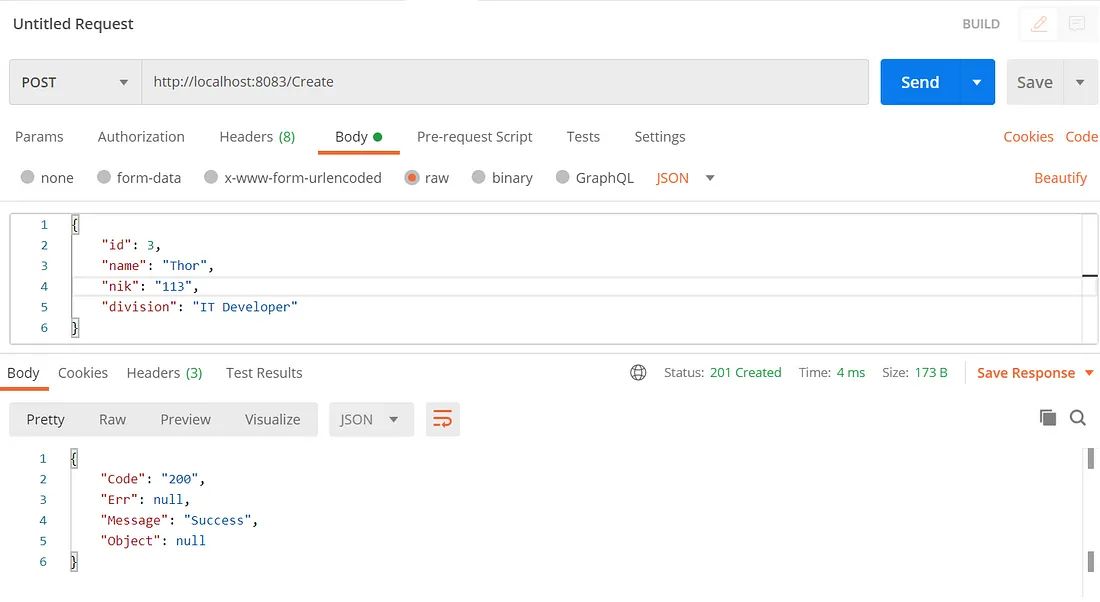
postman post
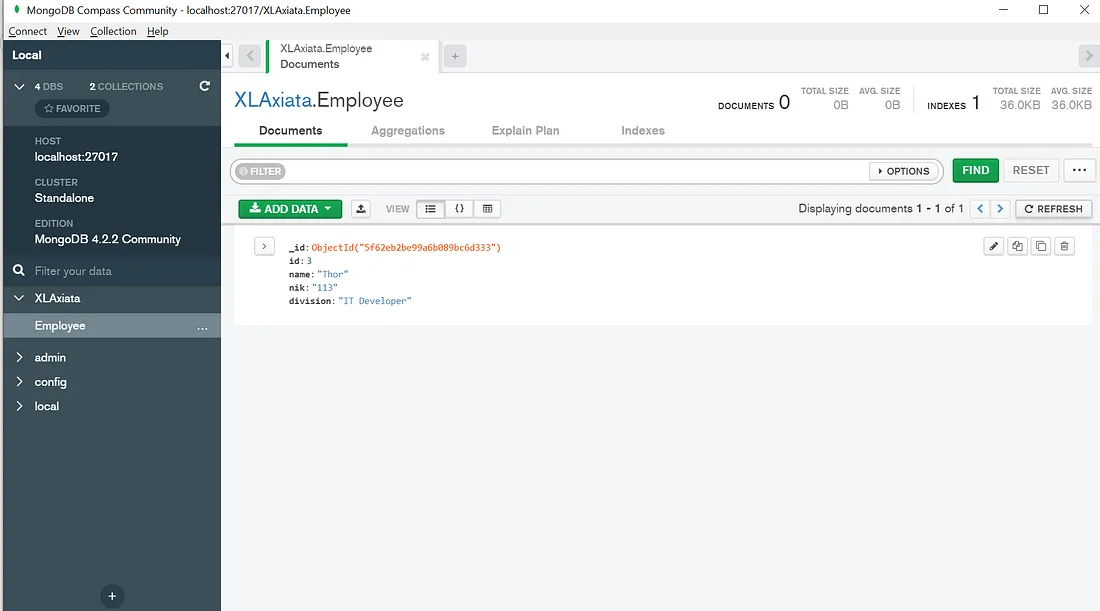
mongodb
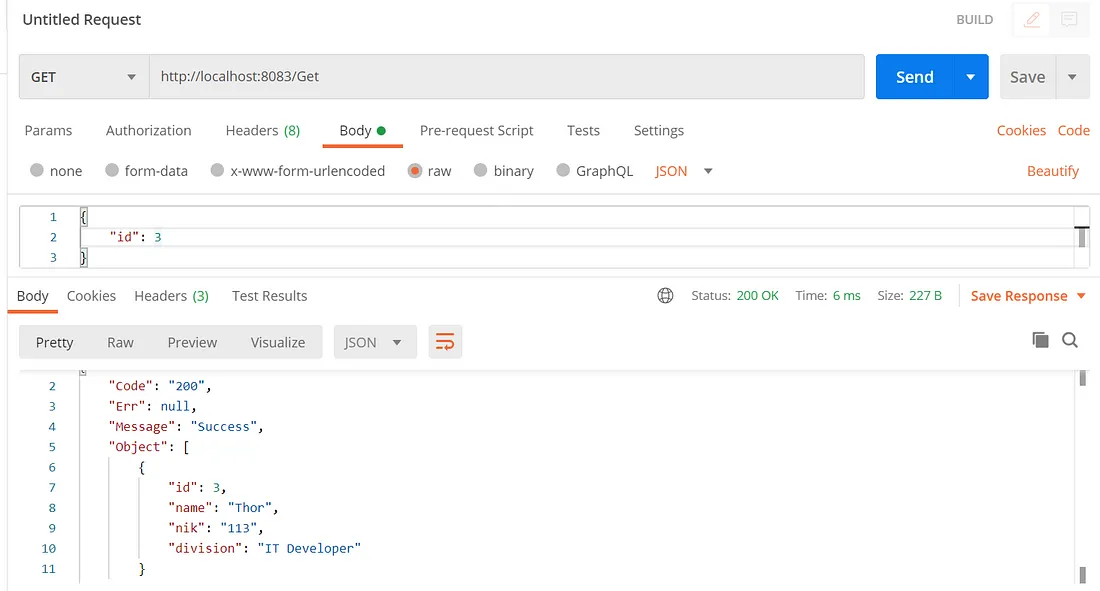
postman get
 © Izzat.