Creating REST API Clients in Golang — Learning Golang
INTRODUCTION
In this article, we will create a REST API Client code that we will use to call services from another REST API by sending requests through HTTP to get responses according to the service we call. As an example, we will use the REST API from the previous project.
PROJECT STRUCTURE
--ProjectGO
---pkg
---src
---controller
---APIClienController.go
---interfaces
---APIClientServices.go
---models
---Employee.go
---Request.go
---Response.go
---services
---APIClientServiceImpl.go
---main.go
MODELS
First, we will create models to map requests and responses from the service we call.
package models

type Employee struct {
	Id          int 	`json:"id"`
	Name      	string  `json:"name"`
	Nik 		string 	`json:"nik"`
	Division	string  `json:"division"`
}
package models
type Request struct {
BaseURL string `json:"baseurl"`
Method string `json:"method"`
Headers map[string]string `json:"headers"`
Body []byte `json:"body"`
}package models
import (
"fmt"
)
type Response struct {
Code string `json:"code"`
Message string `json:"message"`
Object []Employee `json:"object"`
}
func (w *Response) Error() string {
return fmt.Sprintf(w.Code,w.Message, w.Object)
}
func Wrap(code string, message string, object []Employee) *Response {
return &Response{
Code : code,
Message : message,
Object : object,
}
}SERVICE
Next, we will create an interface and a service to send requests to the Service URL that we will call.
package interfaces

import(
	"../models"
)

type APIClientServices interface{

	SendRequest(request models.Request) *models.Response

}
package services
import (
"../models"
"net/http"
"bytes"
"io/ioutil"
"encoding/json"
"fmt"
)
type APIClientServicesImpl struct{
HTTPClient *http.Client
}
func (c *APIClientServicesImpl) SendRequest(request models.Request) *models.Response{
fmt.Println("Endpoint Hit: Get Services")
req,err := http.NewRequest(request.Method, request.BaseURL, bytes.NewBuffer(request.Body))
if err != nil {
fmt.Println("Error NewRequest : ", err)
commonResponse := models.Wrap("500","Failed",nil)
return commonResponse
}
req.Header.Set("Accept", "application/json")
if(request.Headers != nil){
for key, value := range request.Headers {
fmt.Println("key ", key , " value ", value)
req.Header.Set(key, value)
}
}
res,err := c.HTTPClient.Do(req)
if err != nil {
fmt.Println("Error HTTPClient : ", err)
commonResponse := models.Wrap("500","Failed",nil)
return commonResponse
}
defer res.Body.Close()
var response *models.Response
resBody,err := ioutil.ReadAll(res.Body)
if err != nil {
fmt.Println("Error ReadAll Response : ", err)
}
jsonString := string(resBody)
json.Unmarshal([]byte(jsonString), &response)
commonResponse := response
return commonResponse
}CONTROLLER
In this controller layer, we will call the sendRequest service and define the method, service URL, headers, and request body content of the service we call. We typically use the POST or GET method. The service URL is the URL of the REST API we call. In the headers section, we can customize as needed. For example, if an authentication token is required on the Rest API Server, we can add it in the header section. The body is the request we will send, in byte data type.
package controller

import (
	"../models"
	"net/http"
	"io/ioutil"
	"encoding/json"
	"../interfaces"
	"fmt"
)

type APIClientsController struct{
	Client 	interfaces.APIClientServices
}

func (controller *APIClientsController) GetEmployee(w http.ResponseWriter, r *http.Request){
	fmt.Println("Endpoint Hit: Get Controller")

	reqBody, err := ioutil.ReadAll(r.Body)

	if err != nil {
		fmt.Println(w, "Kindly enter data with the event Consta and Value only in order to update")
	}

	jsonString := string(reqBody)
	bytes := []byte(jsonString)

	Headers := make(map[string]string)
	Headers["Content-Type"] = "application/json; charset=utf-8"

	request := models.Request{
		Method	: "POST",
		BaseURL : "http://localhost:8083/GetEmployee",
		Headers	: Headers,
		Body	: bytes,
	}

	w.Header().Set("Content-Type", "application/json")
	w.WriteHeader(http.StatusOK)
	json.NewEncoder(w).Encode(controller.Client.SendRequest(request))

}
MAIN
Next, we will create main.go to call the service and controller that we have created.
package main

import (
	"net/http"
	"./controller"
	"./services"
	"github.com/go-chi/chi"
	"fmt"
)

func main(){
	fmt.Println("Endpoint Hit: API Clients")

	client 			:= &http.Client{}
	service   		:= &services.APIClientServicesImpl{HTTPClient : client}
	controller 		:= &controller.APIClientsController{Client : service}

	r := chi.NewRouter()
	r.Post("/APIClient/GetEmployee", controller.GetEmployee)

	http.ListenAndServe(":8089", r)

}
RESULT
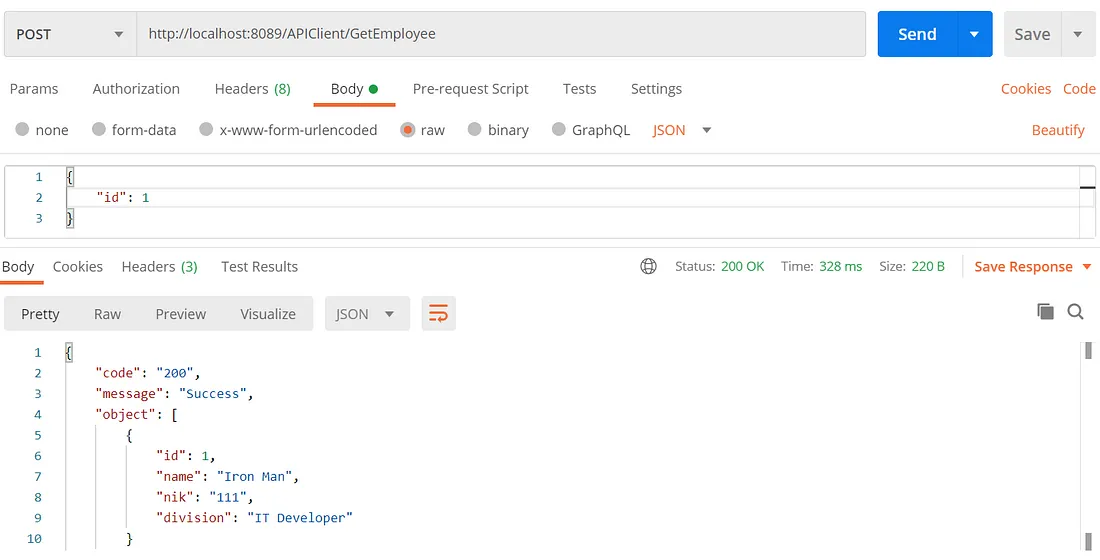
Next, we will try to run main.go and call the service /ApiClient/GetEmployee. If successful, the response given will be the same as the response from the /GetEmployee service in the previous REST API project
Postman Result
 © Izzat.